Private vs. Public Company Tax Obligations
When you register a company in Pakistan, one of your first decisions is the type of company: private limited or public limited. Most founders focus on shareholders, capital and control. Fewer think about how that choice changes the tax and compliance work that follows every year.
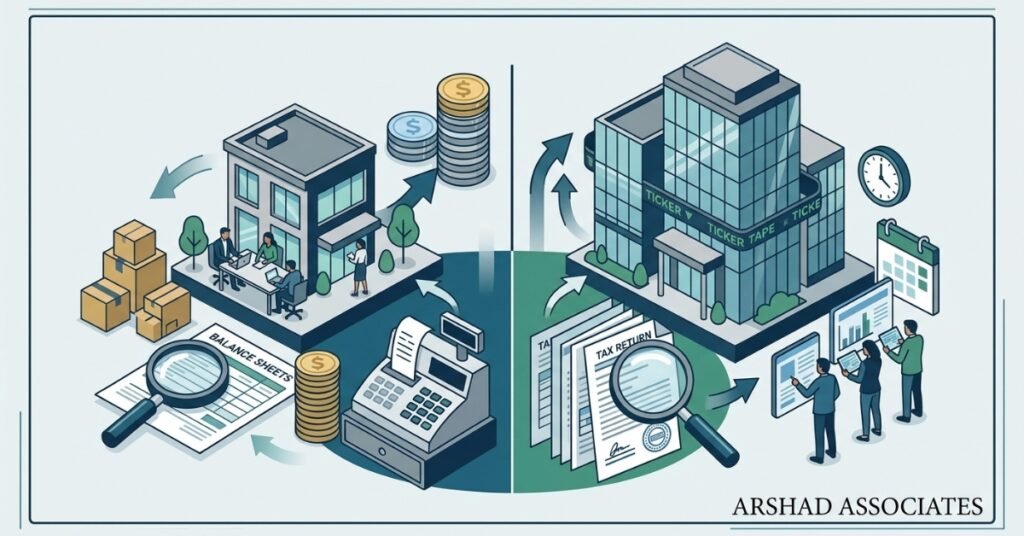
The good news is that the core income tax rules are broadly the same for both types. Both are taxed as companies under the Income Tax Ordinance, 2001, both must maintain audited accounts and both must file returns and withhold tax on payments. The real differences appear in disclosure, governance, dividend treatment and the scale of regulatory oversight.
This article explains where private and public company tax obligations overlap, where they diverge, and what directors should do to stay on the right side of FBR and SECP. Rates and rules change often through Finance Acts, so treat the figures here as general guidance and confirm current rules before acting.
Not Sure Which Tax Rules Apply to Your Company?
Speak to our tax experts for clear, practical advice.
📞 Call: +92331-5661278 💬 WhatsApp Us1. Private vs. Public Company: The Basics
The Companies Act, 2017 recognises several company types. For tax discussions, the two main categories are private and public companies.
Private Limited Company
- Can be formed with as little as one member
- Cannot offer shares to the general public
- Restrictions on share transfer
- Lighter disclosure requirements
- Common for SMEs and family businesses
Public Limited Company
- Needs at least three members
- Can be listed and offer shares to the public
- Shares are freely transferable if listed
- Higher disclosure and governance duties
- Common for large, growing or capital-intensive firms
A public company may be listed on the Pakistan Stock Exchange or remain unlisted. Listed companies face the heaviest obligations because they answer to both SECP and the stock exchange.
2. Tax Obligations Both Company Types Share
Whether private or public, a company in Pakistan is a separate taxpayer. These duties apply to both:
- Corporate income tax: Tax on taxable profits at the applicable corporate rate, which has generally been 29% for most companies, with different rates for specific categories and additional levies such as super tax on high incomes.
- Minimum tax: Tax on turnover where it exceeds the normal tax payable, so loss-making companies may still owe tax.
- Annual income tax return: Filed with FBR along with audited financial statements.
- Advance tax: Quarterly payments based on estimated liability.
- Withholding obligations: Deducting and depositing tax on payments such as salaries, contracts, services and rent.
- Sales tax: Registration, monthly returns and input tax records where the company makes taxable supplies. See our sales tax services.
- Audit: Annual audit by a qualified auditor under the Companies Act, 2017.
- Record keeping: Books and documents kept for the period the law requires.
3. Key Tax and Compliance Differences
Regulatory Oversight
Private companies mainly report to SECP through annual returns and financial statements. Public companies, especially listed ones, must also meet stock exchange rules and corporate governance regulations, including quarterly and half-yearly reporting.
Disclosure and Transparency
Private companies share limited information with the public. Public companies must publish financial statements, notes on related-party dealings and director remuneration, which increases scrutiny on both accounting and tax positions.
Audit Depth
All companies need an audit, but public and listed companies usually face deeper audit work, interim reviews and audit committee oversight. Tax positions in these companies often get closer attention from auditors and regulators. Learn more in our guide to statutory audit in Pakistan.
Treatment of Undistributed Profits
Pakistan's tax law has included provisions that can impose tax where certain companies keep profits undistributed beyond prescribed levels. These provisions have mainly targeted public companies and have changed over time, so check the current text of the law before planning dividend policy.
Shareholder-Level Tax
Dividends paid to shareholders attract withholding tax, and rates vary by factors such as filer status and the type of payer. Gains on shares can also be taxed differently for listed and unlisted shares, which matters for investors in both company types.
4. Side-by-Side Comparison Table
| Feature | Private Company | Public Company |
|---|---|---|
| Governing law | Companies Act, 2017; Income Tax Ordinance, 2001 | Same, plus listing and governance regulations if listed |
| Minimum members | 1 | 3 |
| Corporate tax rate | General corporate rate, with special rates for some categories | General corporate rate, with special rates for some categories |
| Super tax and levies | Applies where income thresholds are met | Applies where income thresholds are met |
| Annual return & audited accounts | Required | Required, with more detailed disclosures |
| Interim reporting | Generally not required | Required for listed companies |
| Corporate governance rules | Basic requirements | Extensive, especially for listed companies |
| Undistributed profits rules | Check current law | May face tax if distribution thresholds are not met |
| Public disclosure | Limited | Extensive |
| Typical compliance cost | Lower | Higher |
5. Dividends, Reserves and Shareholder Tax
Dividend policy is where many directors discover that structure matters. Consider these points when planning distributions:
- Withholding on dividends: The company must deduct tax before paying and deposit it with FBR, so cash planning should include this outflow.
- Filer vs non-filer: Shareholders who are not on the Active Taxpayer List can face higher withholding, so encourage shareholders to stay compliant.
- Retained earnings: Holding large reserves can have tax consequences for certain companies, so review the rules each year.
- Director loans: Transactions between a company and its directors or members should be documented and supported, because poorly recorded loans invite questions during audit.
Combining dividend planning with financial planning and analysis helps you forecast cash needs, tax outflows and shareholder returns before the year closes.
6. Compliance Burden at a Glance
The chart below gives a rough, indicative view of relative compliance effort. It is a guide for comparison, not a measured statistic, and actual effort depends on your size and sector.
7. Annual Tax Compliance Checklist
Use this checklist each year. Dates can change by notification, so verify the current deadline for your financial year.
| Task | Frequency | Applies To |
|---|---|---|
| Monthly sales tax return | Monthly | Both, if registered |
| Withholding tax statements | Monthly / quarterly | Both |
| Advance tax payments | Quarterly | Both |
| Payroll tax deduction and deposit | Monthly | Both |
| Annual audit of accounts | Yearly | Both |
| Annual income tax return | Yearly, generally by the notified date | Both |
| SECP annual filings | Yearly | Both |
| Interim financial reporting | Quarterly / half-yearly | Listed companies |
| Dividend and shareholder reporting | As declared | Both |
Our monthly sales tax filing checklist can help you stay on top of the recurring items, and our corporate tax return filing service covers the annual return end to end.
8. Common Mistakes Directors Make
- Treating the company's money as personal money without proper records of loans, drawings or expenses
- Missing quarterly advance tax and ending the year with surcharge
- Ignoring withholding duties on contractor, rent and service payments
- Weak payroll records, especially for directors' remuneration and benefits. Review our guide to in-house vs outsourced payroll services, and our payroll services
- Not planning dividends and reserves before the year ends
- Late filing of returns, which can be fixed but costs money and attention
9. Which Structure Is Better for Tax?
There is no single answer. Tax should be one factor among several, not the only reason to choose a structure.
Private Company May Suit You If
- You are an SME or family business
- You want lower compliance cost
- You do not plan to raise public capital
- You prefer privacy and control
Public Company May Suit You If
- You plan to raise funds from the public
- You want a listing and share liquidity
- You can handle higher disclosure
- You are building a large, long-term group
Individual business owners may also consider sole proprietorship or partnership. Review how personal and company taxation differ through our individual tax filing service, and read about the best business structure for your business before deciding. Directors who also borrow for property can look at the home loan interest deduction for their personal returns.
10. How Arshad Associates Can Help
At Arshad Associates, we support both private and public companies with practical, compliant tax solutions:
- Tax preparation and annual return filing
- Advance tax, withholding and sales tax compliance
- Audit support and documentation review
- Dividend and reserves planning
- Forecasting through financial modeling
- Payroll and director remuneration compliance
- Advice from experienced tax professionals in Islamabad and Rawalpindi
11. Frequently Asked Questions
Do private and public companies pay the same income tax rate in Pakistan?
Generally, both are taxed as companies under the Income Tax Ordinance, 2001, and the headline rate does not depend on whether the company is private or public. Special rates for certain categories and levies such as super tax can differ, so confirm current rules.
Which company type has more compliance requirements?
Public companies, especially listed ones, have more compliance duties because they must also meet SECP and stock exchange requirements, including stronger governance, disclosure and reporting.
Is dividend taxed differently for private and public companies?
Dividends are subject to withholding tax, and the rate depends on factors such as the recipient's filer status and the payer. Public companies may also face rules on undistributed reserves, so plan distributions with current law in mind.
Does a private company need an audit in Pakistan?
Yes. Under the Companies Act, 2017, companies must have their accounts audited by a qualified auditor, and the audited financials support the income tax return.
Can a private company convert to a public company for tax benefits?
Conversion is usually driven by fundraising and growth goals rather than tax savings. It changes compliance, disclosure and sometimes tax treatment, so get professional advice before deciding.
Need Help With Company Tax Compliance?
Let Arshad Associates handle your returns, withholding and tax planning.
📞 Call: +92331-5661278 💬 WhatsApp UsRelated Articles
Disclaimer: This article is for general information only. Tax rates, thresholds and rules change through Finance Acts and notifications. Consult a qualified tax professional before making decisions for your company.