What's My Income Tax Rate
in Pakistan 2026?
Your complete, plain-English guide to FBR income tax slabs — for salaried employees, business owners, freelancers, and property investors — with real numbers, real examples, and expert guidance.
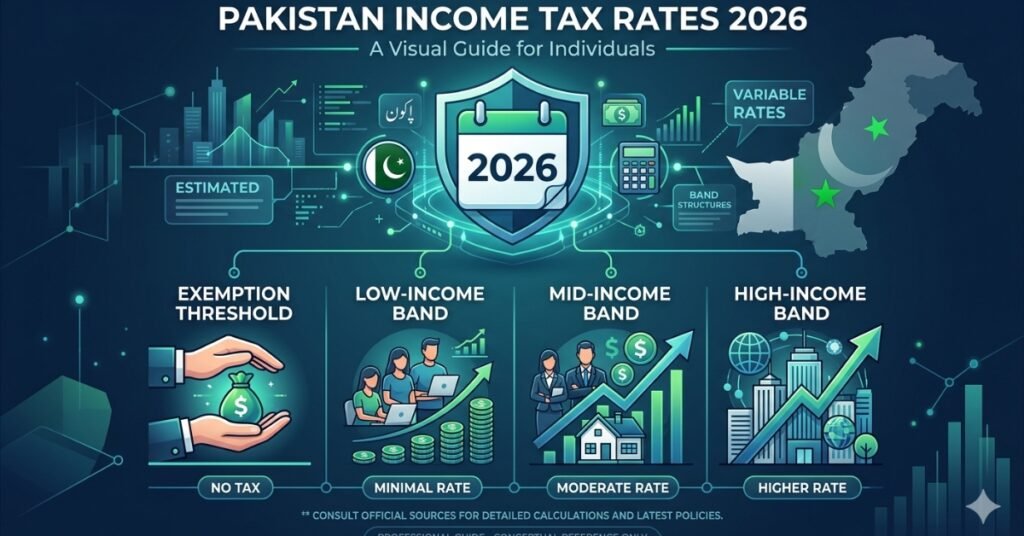
Pakistan's income tax system in 2026 is structured around multiple slab tables — different rates apply depending on whether you are a salaried employee, a business owner, a freelancer, or earn rental and capital gains income. The Federal Board of Revenue (FBR) updated tax slabs under the Finance Act 2025, introducing revised rates and thresholds that every taxpayer must understand before filing. This guide breaks down every major tax slab category in plain language, shows you exactly how much tax you owe at different income levels, highlights key reliefs and exemptions, and explains what steps to take to remain compliant — or to reduce your tax burden legally. Whether you are filing for the first time or reviewing your obligations for 2026, this is your definitive reference.
📑 Table of Contents
- How Pakistan's Income Tax System Works in 2026
- Salaried Person Tax Slabs 2025–26
- Non-Salaried / Business Income Tax Slabs
- AOP (Association of Persons) Tax Rates
- Rental Income Tax Rates
- Freelancer & Digital Services Tax
- Capital Gains on Property
- Filer vs Non-Filer: The Tax Difference
- How to Legally Reduce Your Tax in Pakistan
- How to File Your Income Tax Return (Step-by-Step)
- Frequently Asked Questions
- Related Articles
1. How Pakistan's Income Tax System Works in 2026
Pakistan operates a progressive income tax system, meaning the higher your income, the higher the percentage you pay — but only on the portion of income above each threshold. The Federal Board of Revenue (FBR) administers income tax under the Income Tax Ordinance 2001, with tax rates updated annually through the Finance Act.
For the tax year 2025–26 (July 1, 2025 to June 30, 2026), the FBR has maintained a multi-slab structure with different rate schedules for different categories of taxpayers. The most critical distinction is between salaried and non-salaried income — they follow entirely different rate tables. Rental income, capital gains, and freelancer income each have their own rules on top of this.
Every individual whose annual income exceeds Rs 600,000 (Rs 50,000 per month) is legally required to file a tax return and, where applicable, pay income tax. Failing to file when required classifies you as a non-filer — a status that triggers significantly higher withholding tax rates on everything from bank transactions to property purchases. To understand whether you need to file at all, read our guide: Should I Become a Tax Filer?
Not Sure How Much Tax You Owe in 2026?
Our FBR-registered tax experts at Arshad Associates calculate your exact liability, identify all available deductions, and file your return accurately — so you never overpay or face penalties.
2. Salaried Person Tax Slabs 2025–26
If more than 50% of your income comes from a salary or employment, you are classified as a salaried person by FBR. The salaried category has lower tax rates compared to non-salaried individuals — a deliberate policy to ease the burden on employees. The following slabs apply for the tax year ending June 30, 2026:
| Annual Income (PKR) | Tax Rate | Tax on Band | Total Tax Payable |
|---|---|---|---|
| Up to 600,000 | 0% | Nil | Rs 0 |
| 600,001 – 1,200,000 | 5% | 5% of amount over 600K | Up to Rs 30,000 |
| 1,200,001 – 2,200,000 | 15% | Rs 30,000 + 15% of excess over 1.2M | Up to Rs 180,000 |
| 2,200,001 – 3,200,000 | 25% | Rs 180,000 + 25% of excess over 2.2M | Up to Rs 430,000 |
| 3,200,001 – 4,100,000 | 30% | Rs 430,000 + 30% of excess over 3.2M | Up to Rs 700,000 |
| Above 4,100,000 | 35% | Rs 700,000 + 35% of excess over 4.1M | Progressive |
Practical Example: A salaried employee earning Rs 150,000/month (Rs 1.8M/year) pays: Rs 30,000 (on the Rs 600K–1.2M band at 5%) + Rs 90,000 (on the Rs 1.2M–1.8M band at 15%) = Rs 120,000 total tax per year — or Rs 10,000/month deducted at source by their employer.
3. Non-Salaried / Business Income Tax Slabs 2025–26
If you earn income from a business, profession, sole proprietorship, consultancy, freelance work (above the IT exemption threshold), or any self-employment activity, you are taxed as a non-salaried individual. Rates in this category are higher than salaried at equivalent income levels — reflecting the additional ability to claim business deductions.
| Annual Income (PKR) | Tax Rate | Tax Calculation |
|---|---|---|
| Up to 600,000 | 0% | No tax |
| 600,001 – 1,200,000 | 15% | 15% of amount exceeding Rs 600,000 |
| 1,200,001 – 1,600,000 | 20% | Rs 90,000 + 20% of amount exceeding Rs 1.2M |
| 1,600,001 – 3,200,000 | 25% | Rs 170,000 + 25% of amount exceeding Rs 1.6M |
| 3,200,001 – 5,600,000 | 30% | Rs 570,000 + 30% of amount exceeding Rs 3.2M |
| Above 5,600,000 | 35% | Rs 1,290,000 + 35% of amount exceeding Rs 5.6M |
4. AOP (Association of Persons) Tax Rates
An Association of Persons (AOP) — such as a partnership firm, a family business, or a joint venture operating under a common name — is taxed as a separate entity at rates that mirror the non-salaried individual slabs. Each AOP member is additionally taxed on their share of the AOP's profit in their individual return if the total AOP income exceeds Rs 400,000.
🏢 Key Rules for AOPs in Tax Year 2025–26
- AOP income up to Rs 600,000 — exempt from tax at entity level
- AOP income above Rs 600,000 — same slab rates as non-salaried individuals apply
- Individual members pay tax on their share of AOP profit on top of their own income
- AOP must file a separate income tax return (NTN required for the AOP itself)
- Super Tax at 10% applies to AOPs with income above Rs 150M
- Professional AOPs (law, accounting, consulting) may be subject to minimum tax rules
5. Rental Income Tax Rates 2025–26
Rental income from immovable property (residential or commercial) is taxed at a separate, flat rate schedule — it is NOT added to your other income and taxed at the same slab. Instead, the following specific rates apply based on annual gross rental receipts:
| Annual Gross Rent (PKR) | Tax Rate | Nature |
|---|---|---|
| Up to 200,000 | 0% | Exempt |
| 200,001 – 600,000 | 5% | On gross rent (no deductions) |
| 600,001 – 2,000,000 | 10% | On gross rent |
| 2,000,001 – 4,000,000 | 15% | On gross rent |
| Above 4,000,000 | 20% | On gross rent — final tax |
Rental income tax is a final tax — meaning once you pay the applicable rate, no further income tax is due on that rental income, regardless of your other income. However, you must still declare rental income in your annual return to remain a compliant filer.
6. Freelancer & Digital Services Tax — Pakistan 2026
Pakistan's IT and freelancing sector benefits from significant tax incentives to encourage formal registration and foreign exchange earnings. The FBR and the Government of Pakistan have historically provided preferential tax treatment for IT exports and freelance digital income remitted to Pakistan through official banking channels.
💻 Freelancer & IT Export Tax Rules 2025–26
Exempt Income (No Tax)
Income from IT services and IT-enabled services exported by a registered company is exempt from income tax until June 30, 2026 — provided the income is received in foreign currency through Pakistani banking channels and the taxpayer holds a valid registration with Pakistan Software Export Board (PSEB) or equivalent.
Individual Freelancers
Individual freelancers (not registered as a company) earning from foreign clients may claim the 100% tax credit on foreign remittances if received through banking channels — effectively bringing their tax to 0% on qualifying IT income. This benefit is available upon filing a tax return and declaring the income.
Minimum Tax (1%) on Turnover
Freelancers and IT companies with turnover above Rs 100M who do not qualify for the exemption are subject to a minimum tax of 1% of turnover if their regular tax liability is lower than this threshold.
Non-Qualifying Digital Income
Freelance income from local clients, or foreign income not remitted through official channels, is taxed as regular business income under the non-salaried slab rates above.
7. Capital Gains Tax on Property (2025–26)
Profits from selling immovable property are subject to Capital Gains Tax (CGT) in Pakistan. The rate depends on how long you held the property before selling — shorter holding periods attract higher rates to discourage speculation.
| Holding Period | CGT Rate (Open Plot) | CGT Rate (Constructed) | CGT Rate (Flat/Apartment) |
|---|---|---|---|
| Up to 1 year | 15% | 15% | 15% |
| 1–2 years | 12.5% | 10% | 10% |
| 2–3 years | 10% | 7.5% | 7.5% |
| 3–4 years | 7.5% | 5% | 5% |
| 4–5 years | 5% | 2.5% | 0% |
| Above 5 years | 0% | 0% | 0% |
8. Filer vs Non-Filer: How It Affects Your Tax Rate
One of the most impactful decisions any Pakistani individual or business can make is becoming an active tax filer. The difference in withholding tax rates between filers and non-filers is dramatic — sometimes 200–400% higher for non-filers. This affects every major transaction you make.
The penalty of being a non-filer in 2026 extends beyond higher withholding rates — non-filers also face restrictions on purchasing vehicles above Rs 2M, property transactions, and opening foreign currency accounts. For a full comparison, read: Tax Filer vs Non-Filer in Pakistan — Full Comparison.
9. How to Legally Reduce Your Tax in Pakistan 2026
Understanding your tax rate is only half the picture. Equally important is knowing the legal deductions, credits, and exemptions that reduce your taxable income or final tax liability. The Income Tax Ordinance 2001 provides multiple pathways to lawfully minimise what you owe:
Tax Credit on Life Insurance
Premiums paid for life insurance on yourself or your spouse qualify for a tax credit of up to 25% of taxable income or Rs 2.5M, whichever is lower.
Mortgage Interest Deduction
Interest paid on a housing finance loan for your principal residence is deductible — reducing your taxable income directly before the slab rates apply.
Education Expense Relief
Tuition fee payments for children's education qualify for a tax credit — helping families offset the cost of schooling against their income tax bill.
Charitable Donations
Donations to approved non-profit organisations and charities registered under Income Tax Ordinance qualify for tax credits — up to certain income percentage limits.
Business Expenses (Self-Employed)
Non-salaried individuals and business owners can deduct all genuine business expenses — rent, utilities, staff salaries, depreciation, and professional fees — from gross income before tax is calculated.
IT Export Exemption
Registered IT companies and qualifying freelancers earning foreign remittances through official channels can claim full tax exemption on IT export income under the current FBR policy.
10. How to File Your Income Tax Return in Pakistan (Step-by-Step)
Register for NTN (National Tax Number)
Visit the FBR IRIS portal (iris.fbr.gov.pk) or use the mobile app to register for your NTN using your CNIC. Businesses also need to register their AOP or company separately.
Gather Your Income Documents
Collect salary certificates, bank statements, rent agreements, business accounts, asset details (property, vehicles), and any withholding tax certificates received throughout the year.
Log into FBR IRIS Portal
Log in to your IRIS account, navigate to "Declaration" and select the appropriate return form for your category — salaried, business, or AOP.
Declare All Income & Assets
Enter all sources of income, claim applicable deductions and credits, declare foreign assets and remittances, and review the auto-calculated tax liability before submission.
Pay Any Outstanding Tax
If your return shows tax payable (after deducting withheld amounts), generate a Payment Slip ID (PSID) from IRIS and pay via your bank or online banking. The deadline for salaried individuals is typically September 30.
Submit & Save Acknowledgement
Submit the return digitally on IRIS and download the filing acknowledgement. Your Active Taxpayer List (ATL) status updates within 24–48 hours of filing, restoring all filer benefits. For professional assistance with filing, visit our Individual Tax Filing Service.
11. Frequently Asked Questions
📋 Let Arshad Associates Handle Your 2026 Tax Return
From calculating your exact tax liability to filing a fully compliant return and maximising your legal deductions — our FBR-registered experts do everything for you. Serving Pakistan's salaried employees, business owners, freelancers, and property investors.